
Semantic layer · a plain-English guide
Semantic Layer: A Plain-English Guide to Giving Every Number One Meaning
How a semantic layer turns raw data into business terms everyone agrees on. No jargon.
A semantic layer is a shared layer between your raw data and the people and tools that use it. It translates tables and columns into business terms and metrics, such as revenue or active customer, so every report gives the same answer.
Ask three teams for last month's revenue and you may get three numbers. A semantic layer fixes that. It defines revenue once, in plain business terms, and every report and tool uses that one definition.
What Is a Semantic Layer?
A semantic layer sits between your data and the people who use it. It holds the business meaning of your data in one place: what a customer is, what counts as revenue, how a metric is worked out.
People then ask for revenue or active customers in everyday words. They do not need to know which tables to join or which filters to apply.
For a wider definition, see this overview of the semantic layer.
A semantic layer defines your business terms once, so every report uses the same meaning.
The Problem a Semantic Layer Solves
Take one number: revenue. Sales counts an order when it is placed. Finance counts it when it is paid. Support takes refunds off. All three are reasonable, and all three get a different answer.
Three teams, three numbers
Each team builds its own revenue figure. Meetings turn into arguments about whose number is right, and trust in reports drops.
One definition, one answer
Revenue is defined once, for example paid orders minus refunds. Every report and tool uses it, so everyone sees the same number.
How a Semantic Layer Works
- Data sourcesdatabases, files, apps
- Semantic layershared terms and metrics
- Everything that asksreports, dashboards, AI
The semantic layer sits between your data and everything that asks questions of it.
Connect to the data
The layer reads from the places your data already lives.
Define terms and metrics once
Your team writes down what each term means and how each metric is worked out.
Share them everywhere
Reports, dashboards, apps and AI tools all ask the layer, so they all get the same answer.
What Goes Into a Semantic Layer
Business terms
Names people use, such as Customer and Order.
Metrics
Numbers you track, such as revenue and churn rate.
Relationships
How things connect, such as which orders belong to which customer.
Rules
What counts. For example, exclude test orders.
Descriptions and owners
A plain sentence and a named person for each term.
Access rules
Who can see which data.
Here is an example of how a few metrics might be defined.
| Metric | Plain meaning | Rule | Owner |
|---|---|---|---|
| Revenue | Money from paid orders | Excludes test orders and refunds | Finance |
| Active customer | Someone who bought recently | Bought in the last 90 days; counted once | Sales |
| Churn rate | Customers who left | Customers lost this month divided by customers at the start | Customer success |
Why a Semantic Layer Matters
One answer
Everyone sees the same number.
Faster reports
Teams reuse definitions instead of rebuilding them.
More trust
People believe numbers they can explain.
Self-service
Non-technical people can ask questions in business words.
AI that gets it right
AI tools use your definitions, not guesses.
Fewer fire drills
Fix a definition once, and every report is fixed.
Semantic Layer vs Similar Terms
| Term | The question it answers |
|---|---|
| Semantic layer | What do our business terms and metrics mean? |
| Data warehouse | Where is our data stored? |
| Data catalog | What data do we have? |
| Data ontology | What things exist in our business, and how do they connect? |
| Data pipeline | How does data move and get prepared? |
| BI tool | How do people see charts and reports? |
They work together. Read more about data ontologies and data pipelines.
Semantic Layer Best Practices
0 of 7 done
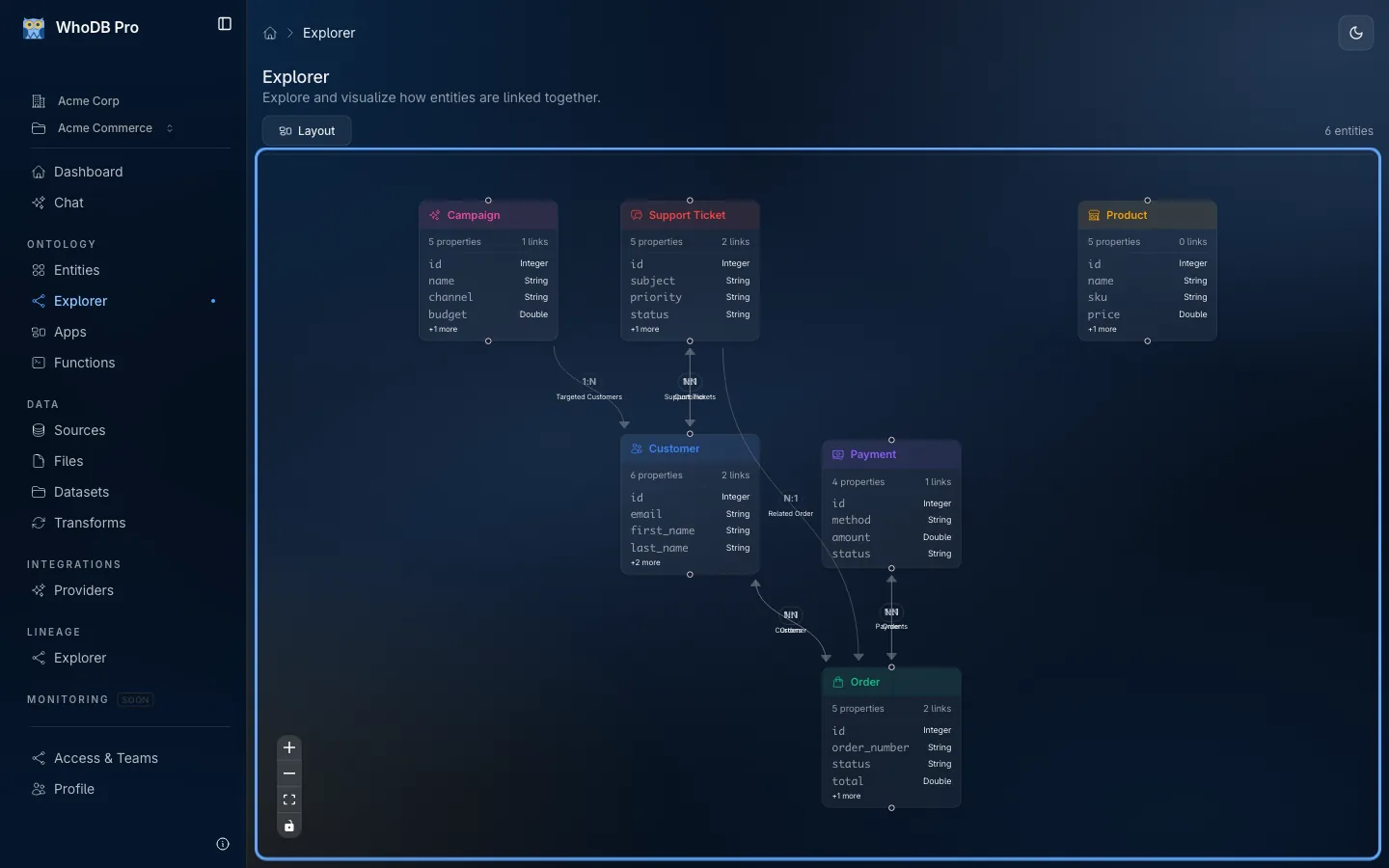
Build a Shared Business Language with WhoDB
WhoDB is a data platform for lineage, pipelines and AI, built by Clidey. It brings your sources, your queries and your team's context into one visual workspace.
Business language for data
Turn tables and columns into entities, properties and relationships people recognize.
Query through the model
Query records through that shared model and follow connected concepts.
Calculate aggregates
Calculate aggregates over connected data.
Trace the source
Follow lineage from a number back to where it came from.
Some WhoDB pages call this a semantic model. To see how it fits your own metrics, check the documentation or talk with our team.
You can connect supported databases in place, without copying the data first. WhoDB runs fully hosted on WhoDB Cloud, or as a Managed Private deployment inside your own cloud. Read about all features or visit the documentation.
How to Get Started With a Semantic Layer
0 of 5 done
Semantic Layer and Related Topics
A semantic layer works best on data you can trust. Data quality checks it, data lineage traces it, database management keeps it safe, and data ontologies describe the things behind it.
Semantic Layer Terms in Plain English
| Term | What it means |
|---|---|
| Metric | A number you track, such as revenue. |
| Dimension | A way to slice a metric, such as by month or region. |
| Business term | A word people use, such as customer. |
| Definition | One clear sentence about what something means. |
| Self-service | Letting people answer their own questions. |
| Single source of truth | One agreed place for each answer. |
| Data model | A description of how data is organized. |
| Governance | The rules and roles for looking after data. |
Semantic Layer FAQ
What is a semantic layer?
A semantic layer is a shared layer between your raw data and the people and tools that use it. It translates tables and columns into business terms and metrics, so every report gives the same answer.
What does a semantic layer do?
It defines business terms and metrics once, in plain words, and lets every report, dashboard and AI tool use the same definitions.
Why do I need a semantic layer?
Without one, each team works out numbers its own way and reports disagree. A semantic layer gives everyone one definition, which builds trust and saves time.
What is an example of a semantic layer?
A company defines revenue as paid orders minus refunds. Every report and tool asks the semantic layer for revenue, so Sales, Finance and Support all see the same figure.
What is the difference between a semantic layer and a data warehouse?
A data warehouse stores your data. A semantic layer sits on top and explains what the data means, using business terms and metrics.
What is the difference between a semantic layer and a data catalog?
A data catalog is an inventory of the data you have. A semantic layer defines how business terms and metrics are worked out.
What is the difference between a semantic layer and an ontology?
An ontology describes the things in your business and how they connect. A semantic layer uses shared terms and metrics so reports agree. They often work together.
What is a metrics layer?
A metrics layer focuses on defining metrics, such as revenue or churn, in one place. It is often treated as a part of a semantic layer.
Who uses a semantic layer?
Analysts, managers and anyone who builds or reads reports. It also helps AI tools, which can use your definitions instead of guessing.
How do I build a semantic layer?
Pick a few metrics people disagree on, agree one definition for each, name an owner, write the rules and use the definitions in your reports. Grow from there.
Does a semantic layer help AI?
Yes. AI tools give better answers when they know what your terms mean and how your metrics are worked out. A semantic layer gives them that context.
How can WhoDB help with a semantic layer?
WhoDB lets you turn tables and columns into entities, properties and relationships people recognize, query through that model and trace where a number came from.
Does WhoDB have a semantic layer?
WhoDB has a business model that gives your data a shared business language, and some WhoDB pages call it a semantic model. Check the documentation to see how it fits your metrics.
One meaning for every number. Start today.
Connect your data and give it a shared business language.