
Data quality · a plain-English guide
Data Quality: What It Is and How to Make Your Data Trustworthy
How to tell whether your data is good enough to rely on, and what to do when it is not. No jargon.
Data quality is a measure of how accurate, complete, consistent, up to date and correctly formatted your data is for the job you need it to do. High data quality means people can trust their reports, plans and decisions.
Good data is like good ingredients. You can be a great cook, but if the food is stale or half missing, the meal suffers. Data quality is how you check your ingredients before you cook. It is not about perfection. It is about knowing what you can trust.
What Is Data Quality?
Data quality describes how good your data is for the job you need it to do. The same list of customers can be perfect for sending a newsletter and useless for a legal notice, because the second needs correct addresses. Quality always depends on the purpose.
Good data quality does not mean perfect data. It means you know where your data is reliable, where it is not, and you catch problems before other people do.
Teams usually judge data quality using six questions. We cover them below, in plain words.
Data quality answers one question: can I trust this data to do the job I need?
Why Data Quality Matters
Poor data quality is expensive because the damage is quiet. A wrong number does not announce itself. It flows into a report, gets quoted in a meeting, and shapes a decision before anyone notices.
Wrong decisions
Leaders act on figures that are out of date, doubled or incomplete.
Wasted time
Teams spend days hunting for the cause of a bad number.
Lost trust
Once one report is wrong, people stop believing all of them.
Customer frustration
Two emails to the same person, a wrong address, a bill that is off.
Extra risk
Bad records can cause billing errors and problems with the rules you must follow.
Missed chances
You cannot spot a trend in data you cannot rely on.
The Six Dimensions of Data Quality
Six questions cover most data quality problems. Each one looks at your data from a different angle.
Is it right?
A customer's phone number is actually theirs.
Is anything missing?
Every order has a delivery address.
Does it match everywhere?
A customer has the same name in sales and in billing.
Is it up to date?
Prices show today's price, not last year's.
Is anything listed twice?
Each customer appears once.
Is it in the right form?
Dates look like dates and emails look like emails.
| Dimension | The question | Everyday example |
|---|---|---|
| Accurate | Is it right? | A customer's phone number is actually theirs. |
| Complete | Is anything missing? | Every order has a delivery address. |
| Consistent | Does it match everywhere? | A customer has the same name in sales and in billing. |
| Timely | Is it up to date? | Prices show today's price, not last year's. |
| Unique | Is anything listed twice? | Each customer appears once. |
| Valid | Is it in the right form? | Dates look like dates and emails look like emails. |
For a wider definition, see this overview of data quality.
Common Data Quality Problems
Most data quality problems fall into a few familiar groups. Once you know them, you start spotting them everywhere.
- Duplicates: the same person appears twice, perhaps as "Jon Smith" and "Jonathan Smith".
- Missing information: blank spaces where an email or address should be.
- Mixed formats: dates written as 03/04 in one place and 4 March in another.
- Out-of-date records: an old address or an old price that was never updated.
- Impossible values: an age of 250 or an order total below zero.
- Disagreements: two systems that show different totals for the same thing.
Many of these start before the data reaches you. That is why data quality and data pipelines go hand in hand.
Everyday Examples of Data Quality Problems
The double email
A customer is stored twice, so she receives every newsletter twice and starts to ignore them. Fix: remove the duplicate and prevent new ones.
The old price
A shop's price list was never updated, so the website shows last season's price. Fix: add a regular check for out-of-date prices.
The report that never matches
Sales says 1,200 orders. Finance says 1,150. One system counts refunds and the other does not. Fix: agree one rule and use it everywhere.
6 Simple Data Quality Checks You Can Do Today
You do not need special software to start. These six checks work on any list or table of data, even a spreadsheet.
1. Look for blanks
Count how many rows have an empty space in an important column, such as email or address. Many blanks mean the data is incomplete.
2. Look for repeats
Sort by name or email and see whether the same entry appears more than once. Repeats inflate your numbers.
3. Look for things that do not make sense
Scan for odd values: negative prices, dates in the future, ages over 120. These point to mistakes.
4. Check how fresh it is
Find the newest date in the data. If it is older than expected, something has stopped updating.
5. Compare totals
Take a total from two places that should agree, such as the shop's sales and the finance report. A gap means a problem somewhere.
6. Check a few against the real thing
Pick five records at random and compare them with the original, such as a paper form or an invoice. It is the simplest test of accuracy.
- Check
- Find
- Fix
- Watch
↺ and around again
Data quality is a loop, not a one-time clean-up.
How to Measure Data Quality
You measure data quality by turning each question into a percentage. For example, if 92 out of 100 customer records have an email address, your email completeness is 92%.
Track a few of these numbers over time. A falling percentage is an early warning that something has changed.
| What you measure | Today | Goal | Status |
|---|---|---|---|
| Customers with an email | 92% | 98% | Needs work |
| Customers listed twice | 3% | 0% | Needs work |
| Orders with an address | 99% | 99% | On track |
| Prices updated this month | 88% | 100% | Needs work |
The numbers above are examples. Use your own.
Try it: score your own data
92% complete
Simple numbers you track every week beat a complicated score nobody understands.
How to Improve Data Quality
- Messyblanks and repeats
- Checkedspot the problems
- Fixedcorrect the data
- Trusteduse it with confidence
Better data quality moves your data from messy to trusted.
0 of 6 done
Who Is Responsible for Data Quality?
Everyone who touches data affects its quality, but someone has to be accountable. The best approach is to give each important set of data a named owner.
Data owner
Answers for the quality of one set of data, such as customers.
Data users
Report problems when something looks wrong.
Technical team
Builds the checks and fixes the causes.
Leadership
Treats data quality as a priority, not an afterthought.
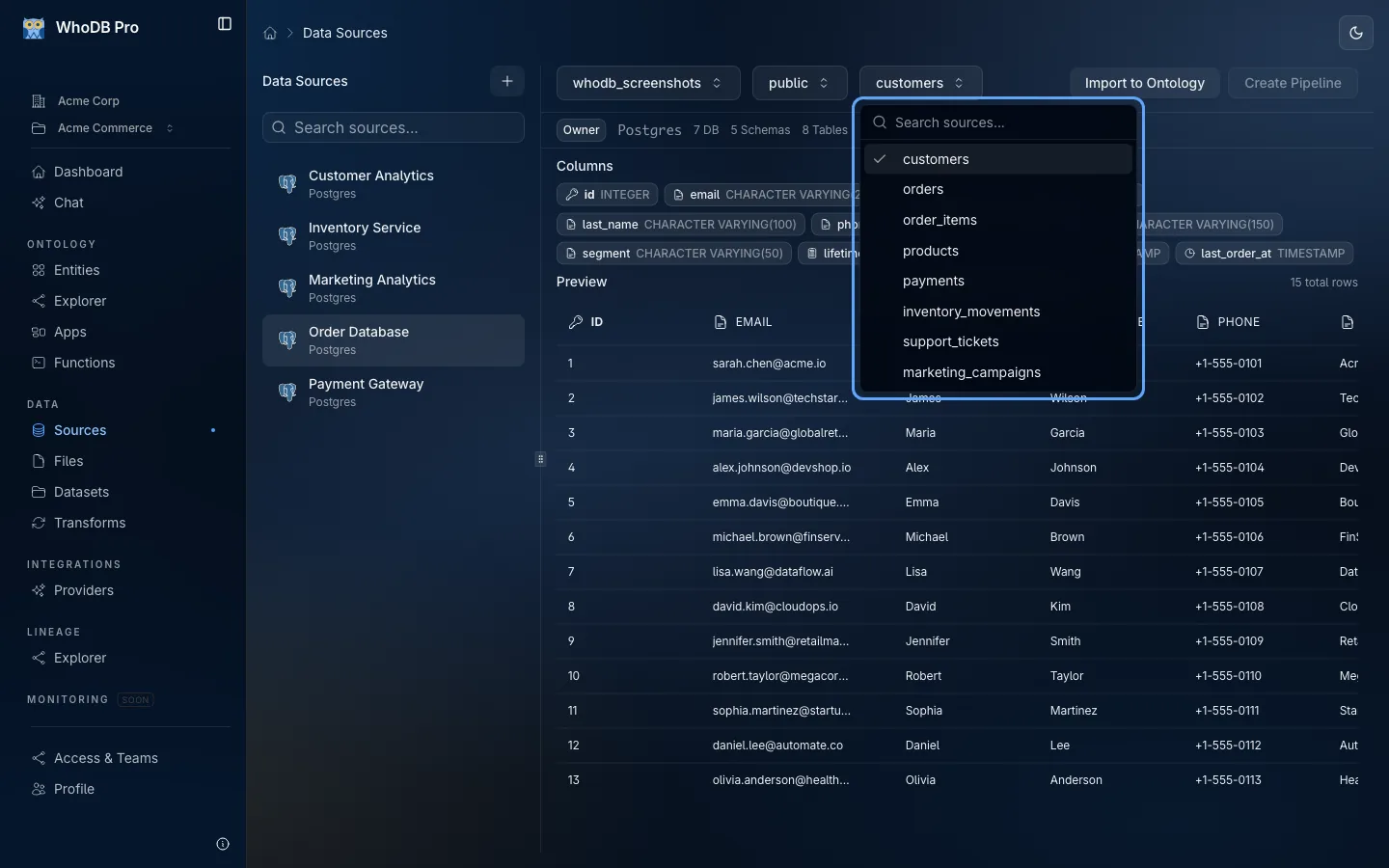
Check Your Data with WhoDB
WhoDB is a data platform for lineage, pipelines and AI, built by Clidey. It brings your sources, your queries and your team's context into one visual workspace. It supports good data quality habits. It does not decide what good data means for your team.
Look at the real records
Explore schemas, inspect records and run queries across your sources in one place.
Ask a question
Ask the AI agent to inspect a source or explain a workflow. It follows each person's permissions.
Trace the cause
Follow lineage back to the step where a problem started, and forward to what it affects.
Keep everyone aligned
Share one view of workflows, owners and the manual checks that matter.
You can connect supported databases in place, without copying the data first. WhoDB runs fully hosted on WhoDB Cloud, or as a Managed Private deployment inside your own cloud. Read about all features or visit the documentation.
Data Quality, Data Pipelines and Data Lineage
Three ideas work as a team. Data pipelines move the data. Data quality tells you whether it is fit to use. Data lineage shows where a problem started and what it affects.
The best place to check quality is at every step of the journey: when data is collected, when it is cleaned up, and before it reaches a report.
Data Quality Terms in Plain English
| Term | What it means |
|---|---|
| Accuracy | How close the data is to the truth. |
| Completeness | Whether anything is missing. |
| Consistency | Whether the data agrees across systems. |
| Duplicate | The same thing listed more than once. |
| Data owner | The person who answers for a set of data. |
| Data cleaning | Fixing or removing wrong, repeated or missing data. |
| Threshold | The score below which you want a warning. |
| Data governance | The rules and roles for looking after data. |
To learn more about data standards, visit DAMA International.
Data Quality FAQ
What is data quality?
Data quality is a measure of how accurate, complete, consistent, up to date and correctly formatted your data is for the job you need it to do.
Why is data quality important?
Poor data leads to wrong decisions, wasted time and lost trust. Good data quality lets people rely on their reports and act with confidence.
What are the main dimensions of data quality?
The six main dimensions are accuracy, completeness, consistency, timeliness, uniqueness and validity. In plain words: is it right, is it all there, does it match, is it fresh, is it listed once, and is it in the right form.
How do you measure data quality?
Turn each dimension into a percentage, such as the share of customers with an email address. Track those numbers over time and set a goal for each.
What is an example of poor data quality?
A customer stored twice receives every email twice. Another example is an old price on a website, or two reports that show different totals for the same thing.
What causes poor data quality?
Common causes include typing mistakes, forms that allow blanks, duplicate imports, systems that do not agree, and information that is never updated.
How can I improve data quality?
Decide what good looks like, fix problems where data first enters, clean what you have, check regularly and give each set of data a named owner.
What is the difference between data quality and data integrity?
Data quality asks whether data is fit for its purpose. Data integrity is about keeping data correct and unaltered over time. Integrity supports quality, but they are not the same.
What is data cleaning?
Data cleaning means fixing or removing data that is wrong, repeated or missing, so that what remains is accurate and consistent.
How often should I check data quality?
As often as the data changes. Weekly checks suit most business data. Important or fast-changing data may need a daily check.
Can I check data quality in a spreadsheet?
Yes. Sort to find repeats, filter for blanks, and compare totals. The six simple checks in this guide work in a spreadsheet.
Who is responsible for data quality?
Everyone who handles data plays a part, but each important set of data should have a named owner who answers for it.
How does data quality relate to data pipelines?
Pipelines move data, and quality checks tell you whether the data that arrived is fit to use. Checking at every step catches problems early.
What tools help with data quality?
You can start with a spreadsheet. As your needs grow, testing tools can run checks on a schedule, and a platform like WhoDB lets you inspect your data, ask questions about it and trace problems to their source.
How can WhoDB help with data quality?
WhoDB helps you look at the real records, ask its AI agent questions about a source, and trace a problem back to where it started. It supports good data quality habits. It does not decide what good data means for your team.
Trust your data. Then check it.
Connect your data and run your first check in minutes.