
Data ontologies · a plain-English guide
Data Ontologies: A Plain-English Guide to Giving Data Meaning
What data ontologies are, why teams use them, and how they help people and AI understand your data. No jargon.
Data ontologies are shared maps of the things your business cares about, such as customers, orders and products, and how those things connect. A data ontology gives everyone the same names and meanings, so people and software read your data the same way.
Your database knows tables and columns. Your team knows customers, orders and products. A data ontology connects the two, so everyone, and every tool, talks about the data in the same words.
What Are Data Ontologies?
The word ontology comes from philosophy, where it means the study of what exists and how things relate. In data, an ontology is a structured description of the things in your business and the links between them.
A table called CUST_TBL_V2 means little to a new colleague. An ontology says something people can read: a Customer is a person or company that buys from us, and a Customer places Orders.
For a wider definition, see this overview of ontologies in information science).
A data ontology is a shared dictionary and map for your business data.
Data Ontologies in Simple Terms
Picture a shop. It deals with customers, orders, products and suppliers. A data ontology names each of these things and describes how they connect.
Every ontology is built from three parts.
Entities
The things you care about: Customer, Order, Product.
Properties
Details about each thing: a Customer has a name and an email; an Order has a date and a total.
Relationships
The links between things: a Customer places an Order, and an Order contains a Product.
Why Data Ontologies Matter
Without a shared meaning, every team describes the same thing in its own way. An ontology ends that.
One shared language
Everyone uses the same names for the same things.
Less confusion
"Customer" means one thing, not four.
Easier to find things
People search by business words, not table names.
Better AI answers
AI tools do better when they know what your terms mean.
Joined-up data
Connect systems that call the same thing by different names.
Faster onboarding
New teammates learn the business and the data together.
Data Ontology vs Similar Terms
Ontologies are often mixed up with nearby ideas. This table shows how they differ.
| Term | What it is | Example |
|---|---|---|
| Schema | How data is stored: tables and columns | A table called orders with a column called total |
| Taxonomy | A simple tree of categories | Shoes, then Running shoes |
| Ontology | Things, their details and the links between them | A Customer places an Order |
| Knowledge graph | An ontology filled with real data | This customer placed this order |
| Data catalog | An inventory of the data you have | A searchable list of tables |
| Semantic layer | Shared business terms and metrics for reports | Revenue means paid orders only |
They work together. Read more about the semantic layer and data lineage.
How to Build a Data Ontology
- List thingscustomers, orders
- Add detailsname, date
- Link themplaces, contains
- Agree namesone meaning
- Use itqueries, AI
Five steps from a blank page to a working ontology.
0 of 6 done
Where Data Ontologies Are Used
Retail
Connect customers, orders and products across shop and website.
Healthcare
Link patients, visits and treatments using shared terms.
Finance
Connect accounts, transactions and customers in one view.
Operations
Follow stock, suppliers and deliveries together.
AI assistants
Give AI tools the business meaning behind your data.
Data teams
Stop re-explaining the same terms in every project.
Data Ontology Best Practices
0 of 7 done
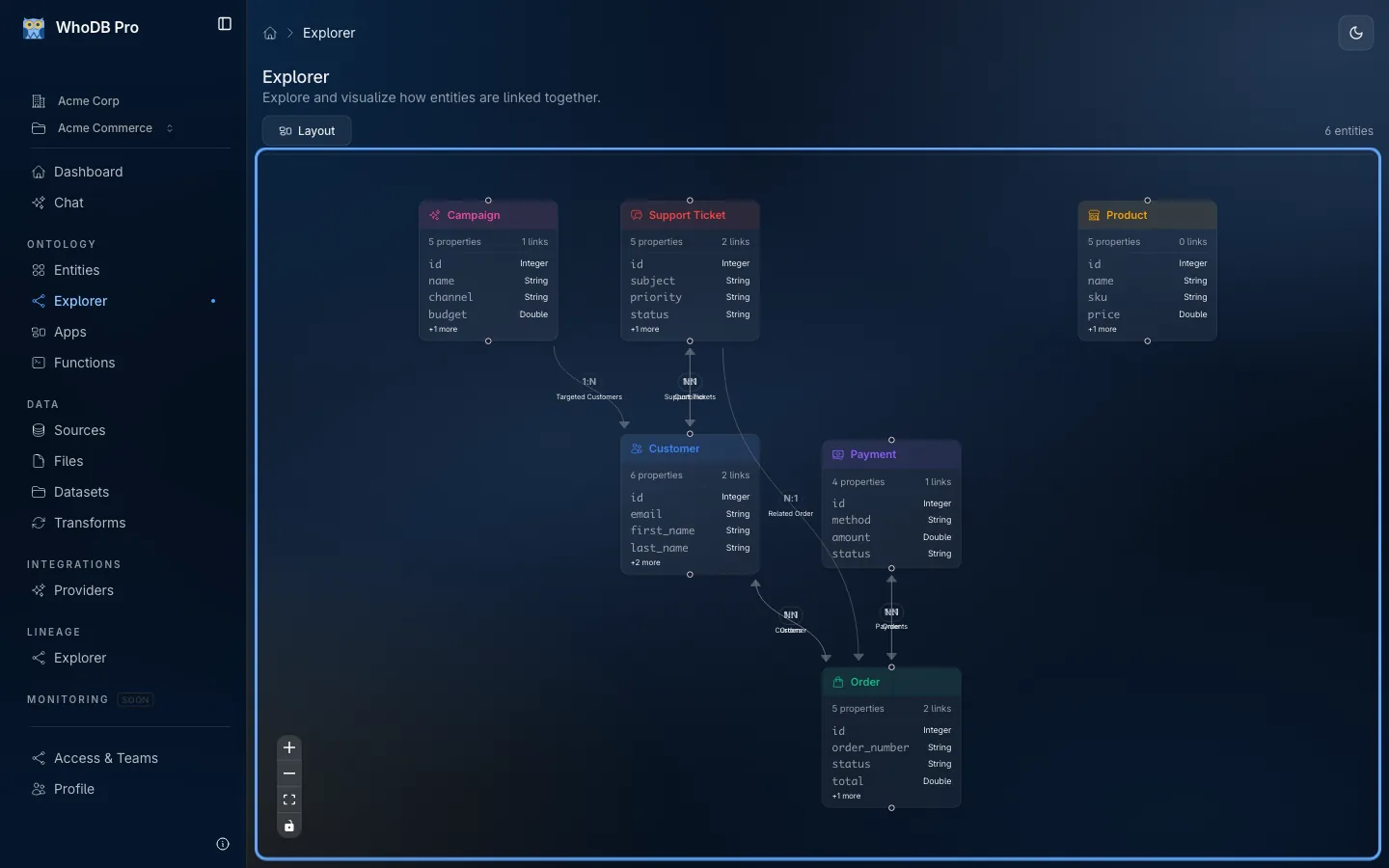
Give Your Data a Business Language with WhoDB
WhoDB is a data platform for lineage, pipelines and AI, built by Clidey. It brings your sources, your queries and your team's context into one visual workspace.
Model your business language
Turn tables and columns into entities, properties and relationships people recognize.
Query through the model
Query records through that shared model and follow connected concepts.
Calculate and look up
Calculate aggregates, and create fast indexed lookups for operational use.
Keep it connected
Your model sits beside your sources, workflows and lineage in one project.
You can connect supported databases in place, without copying the data first. WhoDB runs fully hosted on WhoDB Cloud, or as a Managed Private deployment inside your own cloud. Read about all features or visit the documentation.
Data Ontologies and Related Topics
An ontology gives data its meaning. Data lineage shows where it came from. Data quality checks it. Data pipelines move it, and database management keeps it safe. The semantic layer turns shared meaning into shared metrics.
Data Ontology Terms in Plain English
| Term | What it means |
|---|---|
| Entity | A thing your business cares about, such as a customer. |
| Property | A detail about an entity, such as an email address. |
| Relationship | A link between two entities, such as places or contains. |
| Ontology | A shared map of entities, properties and relationships. |
| Taxonomy | A simple tree of categories. |
| Knowledge graph | An ontology filled with real data. |
| Vocabulary | The agreed list of terms people use. |
| Metadata | Information that describes your data. |
Data Ontologies FAQ
What are data ontologies?
Data ontologies are shared maps of the things your business cares about, such as customers and orders, and how those things connect. They give people and software the same names and meanings.
What is the meaning of ontology in data?
In data, an ontology is a structured description of entities, their properties and the relationships between them. The word comes from philosophy, where it means the study of what exists.
What is an example of a data ontology?
A shop's ontology might say that a Customer places an Order, an Order contains a Product, and a Product is supplied by a Supplier. Each thing also has details, such as a name or a date.
Why are data ontologies important?
They give everyone one shared language, reduce confusion, make data easier to find and help AI tools understand what your terms mean.
What are the parts of a data ontology?
The three main parts are entities, which are the things; properties, which are details about them; and relationships, which are the links between them.
What is the difference between an ontology and a taxonomy?
A taxonomy is a simple tree of categories, such as Shoes and then Running shoes. An ontology also describes details and the many kinds of links between things.
What is the difference between an ontology and a schema?
A schema describes how data is stored, with tables and columns. An ontology describes what the data means in business terms.
What is the difference between an ontology and a knowledge graph?
An ontology is the model: the types of things and links. A knowledge graph is that model filled with real data, such as this customer and this order.
How do data ontologies relate to the semantic layer?
An ontology describes the things and links in your business. A semantic layer uses shared terms and metrics so reports agree. They often work together.
How do I build a data ontology?
Start with a real question, list the main things, add the key details, link them with plain verbs, agree on names and meanings, then try it on real data and improve it.
Do I need special software for data ontologies?
Not to begin. A shared document or whiteboard is enough for a first draft. Software helps once you want to query data through the model.
How can WhoDB help with data ontologies?
WhoDB lets you turn tables and columns into entities, properties and relationships people recognize. You can query records through that model, follow connected concepts and calculate aggregates.
Do data ontologies help AI?
Yes. AI tools give better answers when they know what your terms mean and how things connect. A clear model of your business gives them that context.
Give your data a language your team shares.
Connect your data and model your business in minutes.