
Data lineage · a plain-English guide
Data Lineage Meaning: What It Is and Why It Matters
Know where every number came from, what changed it, and what depends on it. No jargon.
Data lineage is the record of where data comes from, how it changes on the way, and where it ends up. The data lineage meaning is simple: it is the trail that lets you trace any number in a report back to its source.
Data lineage is a receipt trail for your data. When a number looks wrong, you follow the trail back until you find the step that went off. It also works the other way: before you change something, you can see everything that depends on it.
What Is the Data Lineage Meaning?
Data lineage means the life story of a piece of data. It records where the data was created, every step that moved or changed it, and every report or app that uses it now.
Think of a receipt trail. When a total looks wrong, you follow the receipts back until you find the one that does not add up. Data lineage gives you that trail for your data, without the guesswork.
The word comes from family trees. A family tree shows who came from whom. Data lineage shows what each piece of data came from.
The data lineage meaning in one line: the full trail of a number, from where it started to where you read it.
Data Lineage in Simple Terms
Take one number: monthly revenue on a dashboard. It looks like a single figure, but it has a history.
- Collected: orders are saved when customers check out.
- Copied: a nightly job copies the orders to a central place.
- Cleaned: test orders are removed and formats are matched.
- Combined: refunds are added in and the total is worked out for each month.
- Reported: the dashboard shows the result.
Data lineage is the map of those five steps. If revenue looks low on Monday, the map tells you where to look first, instead of checking everything.
Why Data Lineage Matters
Data rarely stays in one place. The more places it passes through, the harder it is to explain a number, and the easier it is to break one by accident.
Trust
People believe a report when they can see where it came from.
Faster fixes
Trace a wrong number back to the exact step that caused it.
Safer changes
See what depends on something before you change or delete it.
Rules and audits
Show where personal information is kept and how it moves.
Smoother moves
Know what to move together when you switch systems.
Quicker onboarding
New teammates learn how things connect in days, not months.
Upstream and Downstream Data Lineage
Data lineage can look in two directions. Upstream looks backward and asks where the data came from. Downstream looks forward and asks what uses it.
- UpstreamWhere did it come from?
- Revenue reportthe number you are looking at
- DownstreamWhat depends on it?
Upstream looks back to the sources. Downstream looks ahead to everything that depends on the data.
You need both. Upstream helps you fix a bad number. Downstream helps you avoid causing one.
Types of Data Lineage
Data lineage can be drawn at different levels of detail. The right level depends on the question you want to answer.
| Type | What it shows | Useful when |
|---|---|---|
| Big picture | Which sets of data feed which others | You want a quick overview |
| Detailed | How each individual item is built from others | You are chasing one wrong number |
| Business view | The flow in everyday words | You are explaining it to non-technical colleagues |
| Technical view | The tools and jobs behind the flow | Engineers need to fix or change something |
| History | What actually ran, and when | You need an audit trail |
Data Lineage vs Similar Terms
Data lineage is often mixed up with nearby ideas. This table shows how they differ.
| Term | The question it answers |
|---|---|
| Data lineage | Where did this data come from, and where does it go? |
| Data provenance | Who created or changed this data, and when? |
| Data catalog | What data do we have, and what does it mean? |
| Data mapping | Which field in one system matches which field in another? |
| Data quality | Is this data right, complete and fit for use? |
| Data pipeline | How does data move and change between systems? |
They work together. A catalog lists your data, lineage connects it, and quality checks tell you whether it can be trusted.
Who Uses Data Lineage?
Analysts
To explain where a number in a report came from.
Data teams
To find the cause of a problem and fix it.
Compliance teams
To show where personal information flows.
Managers
To understand what a change will affect.
New joiners
To learn how the data fits together.
Auditors
To check that numbers can be traced.
Everyday Examples of Data Lineage
The wrong number in the board report
Revenue looks lower than expected. Using lineage, the team sees that a new rule started removing real orders as if they were test orders. They fix the rule in an hour instead of a week.
The form field nobody remembered
Someone wants to delete an old field from a form. Lineage shows three reports still depend on it. The team updates those reports first, and nothing breaks.
The privacy request
A customer asks what data a company holds about them. Lineage shows every place the customer's details were copied, so the company can answer fully.
How Data Lineage Is Created
There are three ways to build data lineage, and most teams use a mix.
Tools that watch the flow
Software reads how data moves and builds the map for you. This stays up to date as things change.
Information built into your systems
Many systems record how things relate. A tool can read these records and show how the pieces connect.
Writing it down
Some flows cannot be seen by a tool, such as a spreadsheet emailed between teams. A short written note beats no record at all.
For a wider definition, see this overview of data lineage.
How to Draw Your Own Data Lineage
You can start today with a pen and paper. Pick one report and follow these steps.
0 of 6 done
| Step | Where it comes from | What happens | Who owns it |
|---|---|---|---|
| 1 | Shop orders | Collected at checkout | Sales |
| 2 | Central store | Test orders removed | Data team |
| 3 | Revenue model | Refunds added, totals made | Finance |
| 4 | Dashboard | Shown to leaders | Finance |
The table above is an example. Fill in your own.
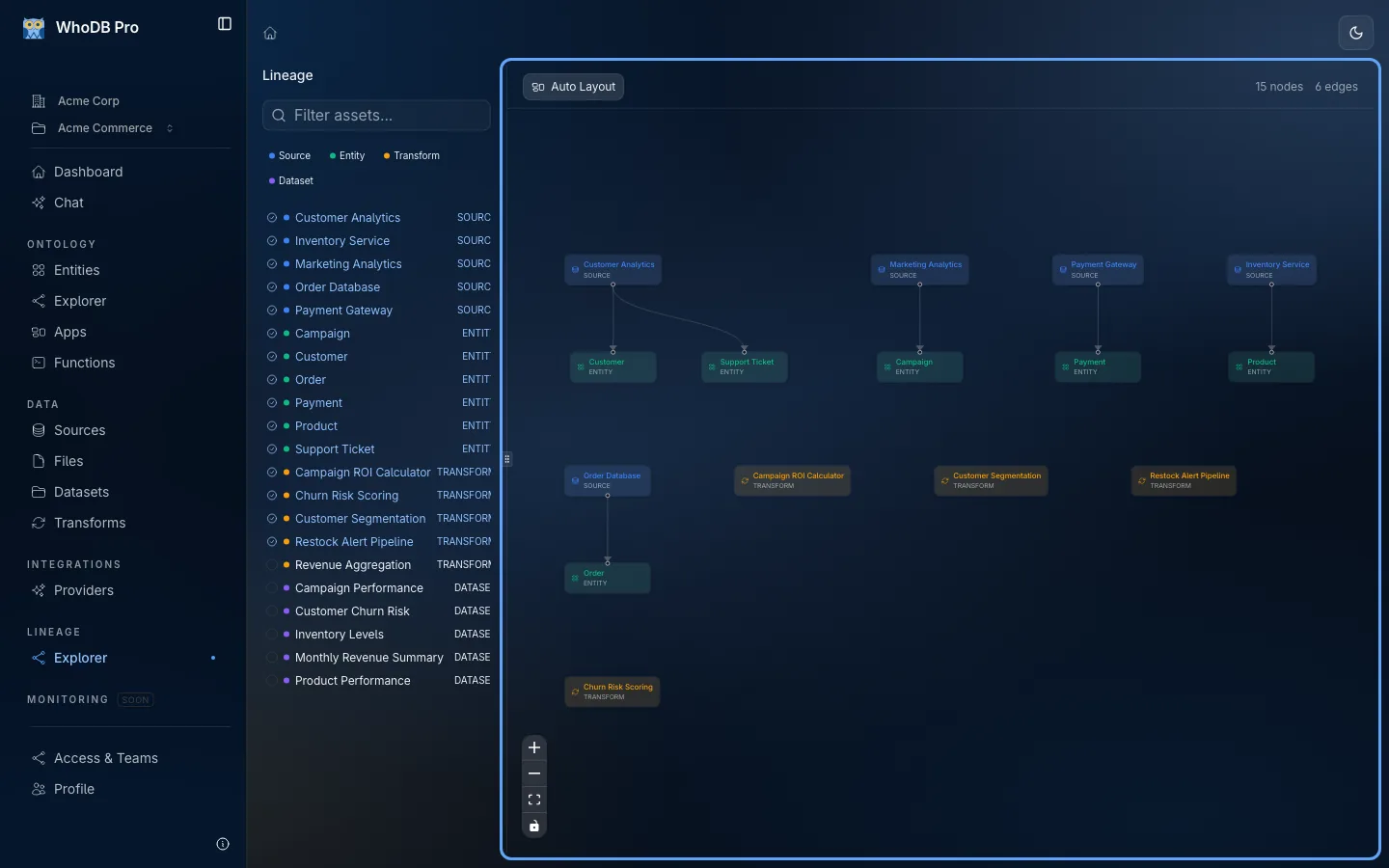
See Your Data Lineage in WhoDB
WhoDB is a data platform for lineage, pipelines and AI, built by Clidey. It brings your sources, your queries and your team's context into one visual workspace. You always know where a number came from and who touched it last.
Both directions
Look back to the source, or forward to every dashboard, app and job that depends on a dataset.
Zoom in or out
Start with one item, or open the full project map.
Bring in your own lineage
WhoDB can bring in lineage through OpenLineage, an open standard.
Check before you change
See the impact before you change something important.
You can connect supported databases in place, without copying the data first. WhoDB runs fully hosted on WhoDB Cloud, or as a Managed Private deployment inside your own cloud. Read about all features or visit the documentation.
Data Lineage, Data Quality and Data Pipelines
These three ideas form a loop. Data pipelines move the data. Data quality tells you whether it can be trusted. Data lineage tells you where a problem started and what it affects.
When a quality check fails, lineage shows the step to fix. When you change a pipeline, lineage shows the reports to protect.
Data Lineage Terms in Plain English
| Term | What it means |
|---|---|
| Upstream | Back toward where the data came from. |
| Downstream | Forward toward what uses the data. |
| Source | The place data starts. |
| Transformation | A change made to data on its journey, such as cleaning. |
| Dependency | Something that relies on something else to work. |
| Audit trail | A record that lets you check what happened. |
| Metadata | Information that describes your data, such as who owns it. |
| Impact analysis | Working out what a change will affect. |
Data Lineage FAQ
What is the meaning of data lineage?
Data lineage is the record of where data comes from, how it is changed, and where it is used. It lets you trace any value in a report back to its original source.
What is data lineage in simple terms?
It is a map of your data's journey. Like a receipt trail, it shows each step a number took from the place it was created to the report where you read it.
Why is data lineage important?
It builds trust in reports, speeds up fixing mistakes, shows what a change will affect, and gives auditors a trail of where sensitive data goes.
What is upstream and downstream data lineage?
Upstream lineage looks backward to the sources a number came from. Downstream lineage looks forward to the reports and apps that depend on it.
What is the difference between data lineage and data provenance?
Data provenance focuses on the origin and history of a piece of data, such as who created it and when. Data lineage follows the flow of data between systems. The terms overlap, and some people use them interchangeably.
What is the difference between data lineage and a data catalog?
A data catalog is an inventory that describes what data you have. Data lineage connects that data by showing how it moves and changes. Many catalog products include lineage.
What is an example of data lineage?
A dashboard shows monthly revenue. Its lineage records that the figure came from shop orders, which were copied overnight, cleaned of test orders, combined with refunds and then added up.
How is data lineage created?
Software can build it by watching how data moves or reading records your systems keep. Where tools cannot see a step, teams write it down by hand.
What are the main uses of data lineage?
The main uses are finding the cause of wrong numbers, checking what a change will affect, supporting audits and privacy rules, moving between systems and building trust in reports.
Is data lineage the same as data mapping?
No. Data mapping defines which field in one system matches a field in another, usually when a connection is first built. Data lineage records how data actually moves and changes afterwards.
How does data lineage help with privacy rules?
Rules such as GDPR expect organizations to know where personal data is kept and how it is used. Lineage gives a documented trail of that flow, which makes audits and customer requests easier.
How does data lineage help data quality?
When a quality check fails, lineage shows which earlier step caused it and which reports are affected. That turns a long search into a short, targeted fix.
What is the difference between business and technical lineage?
Business lineage explains the flow in everyday words for non-technical people. Technical lineage shows the tools and jobs behind it, for the people who build and fix them.
How do I get started with data lineage?
Pick one important number, list every step behind it, and draw the flow from source to dashboard. Add tools later, once you know which parts change most often.
Do I need special tools for data lineage?
Not to begin. A pen and paper or a shared document is enough for one report. As your data grows, tools can keep the map up to date automatically.
Does WhoDB show data lineage?
Yes. WhoDB shows what feeds a dataset and what depends on it, in both directions, and you can zoom from one item to the full project. It can also bring in lineage through OpenLineage.
Know where your data comes from.
Connect your data and see how it fits together in minutes.